The music
A string quartet explained for a first-time listener
Two violins, a viola and a cello: what the four players do, why Haydn matters, and how the four pieces named on the booking page fit the form.
Look at the dates ↗Quick answer
A string quartet is four players, two violins, a viola and a cello, with no conductor. The music is conversational: lines pass between the instruments. For a first concert, listen for who has the tune at any moment and let the rest be accompaniment. The Capuchin Church programme leans on familiar Viennese pieces, so you will recognise several.
The four named pieces
| Piece | Composer | A fact to listen for |
|---|---|---|
| Eine kleine Nachtmusik | Mozart | Completed in Vienna on 10 August 1787, a serenade in four movements |
| Emperor quartet | Haydn | Dates from 1797; the slow movement varies a hymn written for Emperor Francis II |
| Ave Maria | Schubert | Composed in 1825 as a song from Walter Scott’s Lady of the Lake |
| Air | Bach | The slow movement of an orchestral suite, scored for strings and continuo |
Four voices, no conductor
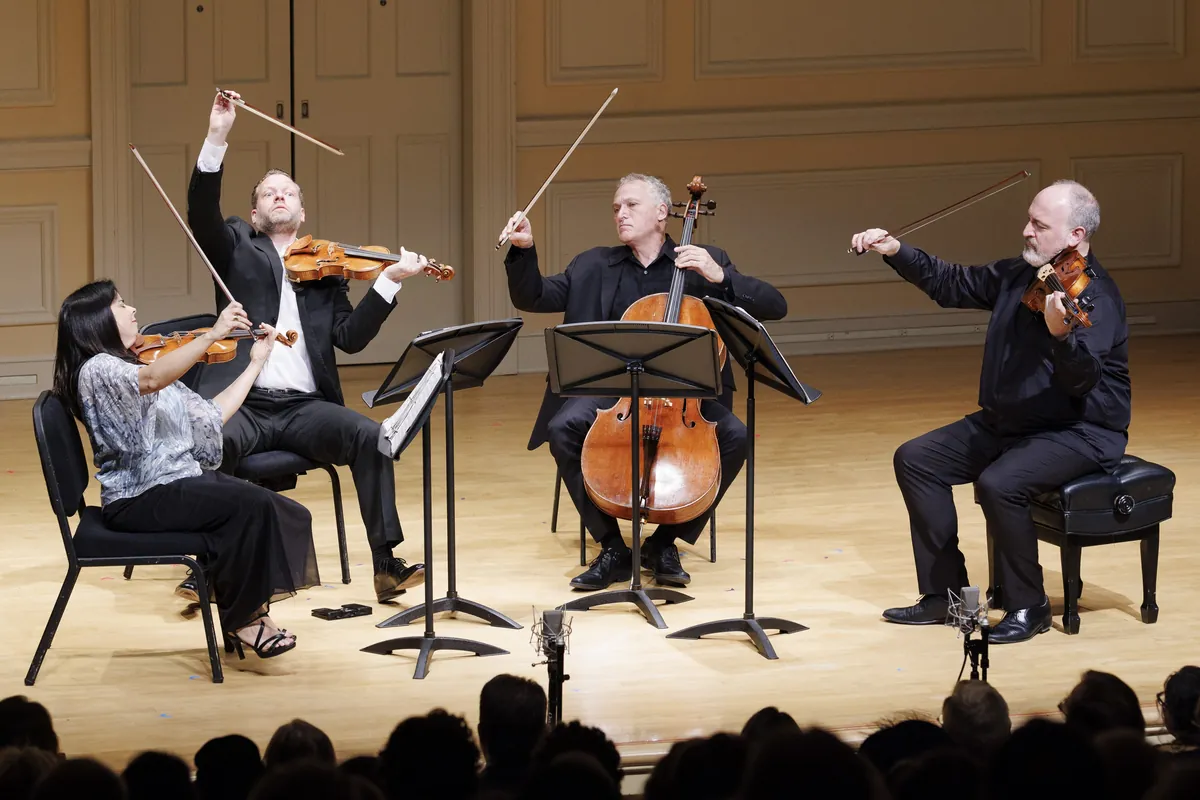
A string quartet means two violinists, a violist and a cellist, and by Wikipedia’s account Joseph Haydn shaped the form that survives today, though he did not invent the genre. The Op. 20 set of 1772 is named as its first major peak. Mozart copied these works as a teenager, and Beethoven pushed the form hard, above all in his late quartets. For the person in the pew the point is simple: four people sit close together and each can be heard. Nowhere to hide is why the quartet is called a test of the composer’s art.
How to listen
Choose one instrument and shadow it for a few minutes, then change. The first violin often carries the tune, the cello usually holds the bass, and the viola and second violin fill the space between. Goethe’s description of four rational people conversing helps: one voice offers a phrase, another replies, a third cuts in, and everything settles. A small church has little echo to blur this, so the exchanges are easy to follow even on a first hearing.
Mozart’s little night music
Mozart’s serenade, catalogued as K. 525, was finished in Vienna on 10 August 1787, according to Wikipedia. It has four movements and, as the article lists it, is scored for two violins, viola, cello and double bass, which explains why string orchestras play it too. A quartet plays it on its own four instruments, with a lighter result. No one knows whether Mozart ever heard it performed, and it did not appear in print until about 1827, over thirty years after he died.
Haydn’s Emperor
The Emperor quartet is the third of Haydn’s six quartets in Op. 76, written in 1797 after his return from London, dedicated to Count Erdődy and published in 1799. Its second movement has four variations on the song Gott erhalte Franz den Kaiser, which Haydn wrote for Francis II. About forty years later the Deutschlandlied was written to that melody, and its third verse is the text of Germany’s anthem today. When the variations begin, the tune is passed between the instruments, which makes it a good place to practise the follow-one-instrument game.
Schubert’s Ave Maria and Bach’s Air
Schubert composed his Ave Maria in 1825 as one of seven songs from Walter Scott’s poem The Lady of the Lake, in Adam Storck’s German translation, and published it in 1826 as part of Op. 52. The famous Latin prayer was fitted to the melody later, which is why many people assume it was written for the prayer. Bach’s Air comes from his third orchestral suite. Wikipedia says an arrangement by the violinist August Wilhelmj gave it the name Air on the G String, and that the movement itself needs only strings and continuo. Both pieces suit a quartet, because their long lines are carried by sustained bowing.
What to expect on the night
The booking page says the quartet specialises in the Viennese classics and gives a free programme leaflet, which is a useful guide to what you will hear. Pieces can vary by date, and the Christmas concerts shift to festive music. If you want to prepare, play the four named works at home once, in any recording, and you will recognise them in the church.
Frequently asked questions
Do I need to know classical music?
No. The pieces named on the booking page are among the best known in the repertoire.
Why no conductor?
Four players can coordinate themselves by listening and watching each other.
Is Eine kleine Nachtmusik written for a quartet?
Wikipedia lists its scoring as two violins, viola, cello and double bass. A quartet plays an arrangement on its own instruments.
Will they play these four pieces?
They are examples from the listing, not a promise for every date.
Sources